Wednesday, 20 April 2016

SEND resources

SEN

Resources for supporting students with Special Educational Needs in Computing


  • There is a collection of ideas for teaching Computing to SEND pupils at: http://sencomputing.wikispaces.com/ Any further contributions welcome. This also has a page linking to resources gathered at the SEND Computing Conference in Dec 2015.
  • Computing ITT and CPD – A collection of teacher-curated resources to deliver the new computing curriculum. Includes a Special Educational Needs and Disabilities page with links to resources, equipment and research.
  • Barefoot Computing Project – A collection of resources to help teachers of Computing, including resources explaining the key computational thinking concepts, and some new teaching activities aimed at teachers of students with SEN.
  • Somerset County Council ELIM SEND Computing Resources – Some excellent resources from the eLearning and Information Management Team, including Computational Thinking for SEN, and Programming Progression for Learners with Complex Needs. There is some additional information on SEND here.
  • http://sheffieldclc.net/ has some Scratch resources for SEND under the Resources tab, both to use as a resource for teaching computational thinking, and also for introducing Scratch.
  • http://gesturesen.wikispaces.com is a very useful wiki on a number of gesture-based technologies for those students with severe and profound learning difficulties, who won’t be able to access the Computing curriculum, but can have meaningful interactions with content through Eye Gaze, iPads, Kinect etc.
  • Revised P Scales for Computing – a group of educators have been working on an alternative to the P Scales for Computing, which don’t really reflect the content of the new Programs of Study. The first draft of this can be viewed in our Resources section here, and will be useful for teachers wanting to know what Computing looks like for young people working at these levels.
  • #CASChat: How do I make Computing appropriate for SEN pupils? – Storify of the #CASChat 6/10/15.
  • Dr Maya Israel’s blog post on inclusion in CS education for code.org.

Wednesday, 23 March 2016

The 4 conditions that support deeper learning

deeper-learning

Deeper learning competencies serve as “North Star” for a new vision of teaching, according to a new report

Teachers must exchange their traditional instructor role for that of a “learning strategist” in order to achieve deeper learning outcomes, according to a new white paper from the nonprofit National Commission on Teaching and America’s Future (NCTAF) and ConsultEd Strategists.
The report’s authors also found that teachers who do achieve deeper learning with their students personalize learning experiences, apply real-world knowledge to learning, and use technology in a way that enhances and empowers student learning.
Deeper learning refers to the competencies, knowledge, and skills that students must develop to be successful post-K-12. There are more than 500 schools across the country that incorporate various types of deeper learning methods.
The white paper, How Deeper Learning Can Create a New Vision for Teaching, describes a new vision for teaching and outlines how teachers’ roles and teaching conditions can best support deeper learning for students.
“Our goal was to highlight and document that teachers need support and training as they make shifts in their practice and in the way they work with colleagues,” said Elizabeth Foster, an author of the white paper and NCTAF’s Vice President for Strategic Initiatives. “We wanted to draw out how teachers, who share a vision of deeper learning for their students, adapt their strategies and take on new roles. In addition, it was also necessary to highlight the kinds of conditions that facilitate teaching for deeper learning, such as a learning culture based on trust and professionalism, shared responsibility for student learning, embedded professional learning, and time for meaningful collaboration.”
Drs. Monica Martinez and Dennis McGrath, ConsultEd Strategists and co-authors of the white paper, analyzed eight schools for their book “Deeper Learning: How Eight Innovative Public Schools Are Transforming Education in the 21st Century,” and drew on that research for this paper.
They found that teachers who are achieving deeper learning outcomes:
• Empower students as learners
• Contextualize knowledge so it is coherent
• Connect learning to real world experiences
• Extend learning beyond the school
• Inspire students by customizing learning experiences
• Purposefully incorporate technology to enhance (not automate) learning
“These strategies are the heart and soul of 21st century teaching and learning,” said Dr. Martinez. “Far too many American schools are not adequately preparing students for the realities of their future work and lives. We hope the examples of what teachers across the country are doing to teach for deeper learning will inspire and inform educators in all schools.”

4 conditions that support deeper learning

“If we are truly going to achieve the kind of learning that is challenging, meaningful and relevant to students lives and experiences , we need to focus on putting conditions in place that support teachers – their learning, their development, and their collaboration time,” said Foster.
The white paper outlines four key conditions, each sequential and building upon one another, that should be in place to enable and support teaching for deeper learning: 1) establishing a learning culture; 2) creating shared responsibility for student learning; 3) establishing a culture of trust and professionalism; and 4) preserving time for teachers to collaborate.
“If these conditions are in place in our schools, then the sky is the limit for all students to thrive in an ever-evolving world,” said Dr. McGrath.
Deeper learning and new roles for teachers
The white paper makes the case that the role of the teacher has to change to that of a learning strategist – an educator who shifts among a range of roles including learning designer, facilitator, networker, and an adviser.
Those new educator roles will include:
• Learning designer: In this role, teachers are adapting learning experiences by backward mapping from specific outcomes to design complex and connected curricula that offer students frequent opportunities to do meaningful work and the opportunity to explore big ideas and essential questions.
• Facilitator: Instead of being the gatekeeper of knowledge, teachers become the gateway to knowledge. Teachers no longer need to be the sole source of information given the access to information that technology provides, so teachers can now shift their role to that of knowledge facilitator.
• Networker: Deeper learning teachers also take on the role of networker as they regularly engage people in the community to enhance their teaching, enrich their curricula and projects, and provide students with access to a wide range of knowledge.
• Advisor: Teachers become involved in interpersonal issues as well, becoming a coach, counselor, or mentor offering advice, encouragement, support and guidance when most needed.
The white paper offers examples of schools across different contexts and settings where teachers have embraced these new roles to engage students in meaningful, personalized learning. Featured schools include: Avalon School in Minneapolis, Minn.; Casco Bay High School in Casco Bay, Maine; High Tech High in San Diego, Calif.; Impact Academy in Hayward, Calif.; King Middle School in Portland, Maine; MC2 STEM High School in Cleveland, Ohio; and Science Leadership Academy in Philadelphia, Penn.
Future recommendations
According to the white paper, the future of teaching embraces a forward-thinking, student-centered approach to learning to ensure students are ready for the future.
Recommendations to support that new vision for teaching include:
• Spread the word. Encourage teachers to share promising practices to make connections between what they are already doing that facilitates deeper learning and new ideas for how to expand their efforts.
• Mirror what we want for students. Just as students need opportunities to develop as curious learners, work collaboratively, and connect with community resources and issues; teachers need the same.
• Begin early. Learning how to teach for deeper learning student outcomes should begin during preparation, before new teachers enter the profession.
• Adapt and reorient existing structures. Policy makers and school leaders should rethink existing policies that could be used more effectively, such as those that address time and planning, assessment of student progress, and professional learning communities.

Thursday, 11 February 2016

Contemporary educational ideas all my staff should know about Tom Sherrington

Key ideas from different sources.
As I look ahead to starting my new job at Highbury Grove,  I’m thinking about all the conversations we are going to have about learning.  To a large degree I want my teachers to be as up-to-date as possible within their own subject domains. They should know the latest OfSTED position ( eg with Moving English Forward or Mathematics: made to measure ) and be up to speed with exam specifications and assessment requirements.  Subject knowledge and subject-specific pedagogical knowledge are going to be key drivers of everything we do.
However, in order to fuel the collaborative effort of reaching the ambitious goals we have for the school, we’ll need to establish a shared conceptual language for talking about teaching across the school as well as within departments. Inevitably, different teachers will have engaged to different degrees with certain ideas depending on the books they’ve read, conferences they’ve been to and blogs they’ve browsed through and the content of their PGCE or other ITE programme.  It strikes me that it would be a huge benefit to us all if we’re more or less on the same page when we’re discussing contemporary ideas about pedagogy, learning, assessment, motivation, neuroscience and so on.   I don’t want people quoting half-remembered snippets from a Dylan Wiliam thing they attended years ago or citing Hattie effect sizes as absolute measures or talking about Growth Mindset, never having engaged with what Carol Dweck has actually written.
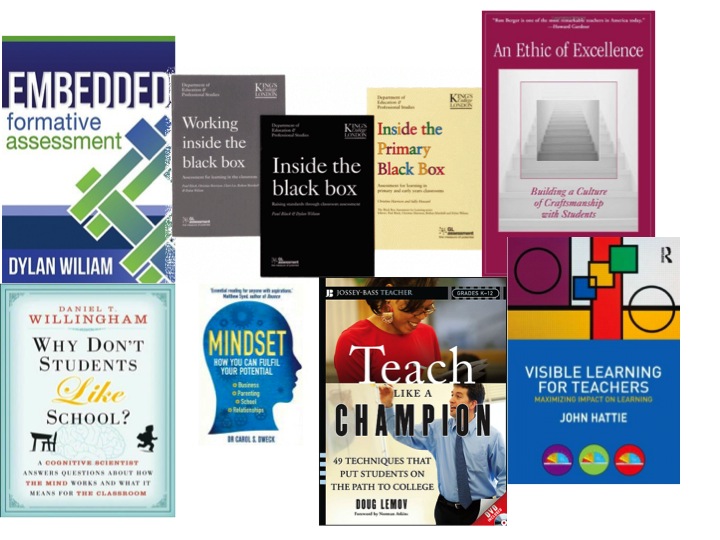
One of my first actions, later this week in fact, will be to buy a ton of books to stock the staff CPD library.  I want to make it easy for everyone to read the books that will inform our discussions.  Already, we’ve bought in copies of Dylan Wiliam’s Embedded Formative Assessment, Hattie’s Visible Learning for Teachers and Martin Robinson’s Trivium 21st C.   But there is so much more for us all to absorb and share.
Over the last two years, I’ve found that I can engage much better with the ideas in some of these books when I’ve seen the authors express their ideas directly – either in person at a conference or through some of the video material on the internet.  In this post I’ve gathered some of the videos that I’ll be recommending that all of my staff engage with at an early stage.  Each one links to a key academic or thinker and their ideas.  Of course, there is also the growing world of teacher bloggers and teacher authors to engage with too and I’ll be promoting general engagement with all of that material – especially the people on my blog roll.
However, to ensure we have strong common ground, I want to focus on a few key researcher-writers and their work:
Visible Learning: John Hattie – the idea of measuring impact
John Hattie’s work provides an important insight into the nature of educational research and the notion of measuring impact.  The idea that some strategies can be shown to have had more impact on average over time relative to others is crucial and his general message about the implications for teachers and the profession is very strong.  This video, (with a counterpart Part 1) gives a very good idea of Hattie’s thinking.  Of course, the effect size concept is problematic and is open to misinterpretation. We’ll need to have that discussion – but people will need to know the principles first.


Formative Assessment: Dylan Wiliam
Dylan Wiliam is someone most people know of even if they haven’t engaged directly with him or his work.  His websitehttp://www.dylanwiliam.org/Dylan_Wiliams_website/Welcome.html is packed with materials to browse through.  He has been leading the way for the last two decades in getting teachers to think about what they’re doing and why. Inside the Black Box was a revelation when we first encountered it back in the 90s.  However, following the national adoption of AfL 10 years ago, lots of the ideas have become rather distorted, spawning various superficial AfL gimmicks or misconceptions about the meaning of ‘formative’ – but I firmly believe that every teacher should know very clearly what Dylan is saying.  This video is one of several recordings of his engaging presentations (cut in at 1 min 30 to get over the long musical intro!)  Alongside his recent book, I think that videos like this could help us to establish a good shared understanding of what we mean by formative assessment and feedback and what these things can look like in practice.

 Lessons from Cognitive Science:  Daniel T Willingham
The field of cognitive science is giving us ever greater insights into how learning works.  There are lots of people in this field but Daniel T Willingham does a very good job of making the ideas accessible and relevant to our school experience.  This book, Why don’t students like school, is a must-read. He provides a handy summary in the concluding chapter which gives a feel for the key ideas and their implications for our practice.  In particular it gives a firm steer in terms of the discourse around thinking, memory, teaching factual knowledge and the need for conscious effort and feedback to secure improvement.
photo (73)
A great summary of Daniel Willingham’s book provided in the concluding chapter.
This interview with Tom Bennett for ResearchEd 2013 gives a superb insight into Dan’s thinking:

I’d also recommend watching this gem of video where Dan explains why learning styles don’t exist:

Robert Bjork and Desirable Difficulties
On YouTube there is a whole series of fascinating short videos where Robert Bjork explains some key findings from his research into memory.  From these you can get an idea of his findings and the general idea of ‘desirable difficulties’ necessary to secure long-term memory, possibly at the expense of the sense of short-term progress.  This clip is a good introduction but I’d recommend watching them all.  If we can all talk about storage, retrieval, interleaving and so on, we’ll be in a better place.

An Ethic of Excellence: Ron Berger
Ron’s book is an inspiration to many people who read it.  The attitudes that is promotes are so powerful, providing significant food for thought as we look at shaping our ethos.   A specific example is shown through this classic Austin’s Butterfly video about the power of critique.  It’s the spirit of it that is most crucial – that we shouldn’t accept mediocrity from any student; we should have aspirational goals for everyone and use specific techniques to enable students to reach them.   I’ll be referring to Austin’s Butterfly a lot – as I have done in a couple of blog posts here and here.

 Guy Claxton and ‘below the line’ learning
I find that Guy Claxton is often misrepresented as being ‘anti-knowledge’ or his ideas are adopted by evangelicals who elevate Building Learning Power to the level of some kind of concrete theory of learning that must be followed almost on principle.  For me, Guy’s ideas and his mode of presentation, provide a useful provocation to question some of our assumptions about what we learn, how we learn and why we learn in certain ways.  The idea that pedagogy could be devised to deliver a deep, knowledge-rich curriculum that simultaneously gives space for students to develop certain dispositions that might serve them well in the future – is inviting. It might be difficult to deliver without losing one or other aspect and that’s the challenge. But the idea is sound and certainly worthy of debate in a school.   To me, Guy is promoting ‘knowledge AND dispositions’, not one or the other. Here he is:

 Carol Dweck: Growth Mindset.
Growth Mindset is so in vogue at the moment, it is natural for anyone who has been hit by a bandwagon to approach this cautiously. However, as with Guy Claxton’s ideas, there is great power in considering the extent to which  student attitudes to learning are influenced at every level of the school – in all of the messages we give in public and in the classroom.  The issue of labelling students such that they have their horizons limited or are lulled into complacency is very common; we’re all guilty of it to some degree.  Here Carol is setting out the key ideas:

Pygmalion Effect: Robert Rosenthal
This video tells the story of some research that shows the power of teacher expectations. It links in with Hattie’s research – as this is one of the highest effects he cites.  Higher teacher expectations lead to better outcomes.  Obvious? Well – it’s worth watching this to see how teachers can change their interactions with students leading to better outcomes when their expectations are raised deliberately:

 Doug Lemov:  Practice and Rigour
I’d like my staff to know about Doug Lemov and his two books: Teach Like A Champion and Practice Perfect.  Of course the American context is different but there is huge merit in engaging in several of Doug’s ideas.  Strategies like 100% or Right is Right show how very high expectations and rigour in discussion can be achieved.  His ideas about teachers’ practice are also very interesting – we won’t get better as fast as we could if just repeat our mistakes over and over again in lessons.   We need to rehearse and practice specific strategies until we do them better.

Martin Robinson: The Trivium 21st C
I have already sent my staff a suggested reading list and this wonderful book was at the top.  I’ve written about the book in this review and I am very excited about working with my staff (and with Martin’s Trivium network) to explore how the ideas behind Grammar, Dialectic and Rhetoric can be brought to life in the classroom and beyond.
@SurrealAnarchy Martin Robinson's wonderful book
@SurrealAnarchy Martin Robinson’s wonderful book
Lesson Study
The NTEN Lesson Study Cycle.
I’d like all of my staff to know in principle what Lesson Study is and how they could engage with it if they choose.  I might use some of my own posts on this to get people started but, beyond that, there is a wealth of literature we can access via NTEN and other sources.    The first step is to make sure everyone knows about it.
There are lots of other ideas we’ll need to wrestle with together – ideas about Behaviour Management, technology and assessment  for example. The goal should be that we’re always seeking to make sure the latest thinking is made available to everyone and that everyone does their best to engage with it.   That way we’ll have the most fruitful discussions about taking the school forward.

Tuesday, 9 February 2016

The power of feedback

In a review of the available research titled "The Power of Feedback," University of Auckland professors Helen Timperley and John Hattie highlight the importance of supplying learners with specific information about what they are doing right or wrong.
For example, feedback like "Great job!" doesn't tell the learner what he did right, and likewise, a statement such as "Not quite there yet" doesn't give her any insight into what she did wrong and how she can do better the next time around.
Instead, researchers suggest taking the time to provide learners with information on what exactly they did well, and what may still need improvement. They also note that it can be helpful to tell the learner what he is doing differently than before.
Has a student's performance changed or improved since the last time you assessed her? Let her know about it, even if she still has a long way to go.
Thanks to our friends at www.edutopia.org for providing us with this great tip! For more tips like this one, click here

Friday, 29 January 2016

7 fun apps to build student thinking skills

7 fun apps to build student thinking skills

BY STEPHEN NOONOO, EDITOR, @STEPHENOONOO
November 20th, 2015

Challenge logic and thinking skills with these apps
thinking-skillsLooking to give students — or your colleagues — a way to hone their thinking and problem-solving skills while having fun? These free puzzles and games might do the trick.
The website APPitic.com, an app resource site with more than 6,000 apps in more than 300 subcategories, offers a number of apps to help build student thinking skills.
Here, we’ve gathered a handful of those apps, and you can access more on the APPitic site. All apps were originally curated by Apple Distinguished Educators.
Animal Sudoku
This twist on the classic Sudoku puzzles assigns an animal to each number, ramping up the concentration required to solve each puzzle.
Chess With Friends
Multiplayer chess game lets users play against each other or find random opponents. However, it requires a Facebook or Games With Friends login.
Tangram XL
Simple version of the popular Tangram puzzles designed with kids in mind. It is designed to avoid unnecessary decoration to keep kids’ attention on geometric concepts.
Finger Physics (web and Android)
Fit together different and moving shapes to solve puzzles. The free version features around 100 levels with various objectives and difficulty levels.
Flow Free
Connect matching colors with pipe to create a flow. Pair all colors, and cover the entire board to solve each puzzle. But watch out, pipes will break if they cross or overlap.
Genius Brain
Using clues, players must identify in which column a given icon is located on a large board in this version of Einstein’s puzzle. It is aimed at improving your visual memory, ordering your thinking, helping form cause-effect relations, and more.
Monorail
Draw lines to connect “stations” and create a working monorail system in this game that challenges visual/spacial/geometric skills. According to the developers, Kindergartners can solve the beginner levels. Mathematicians from MIT have struggled to solve the most difficult ones.

Flipped learning is changing the face of special ed

Flipped learning is changing the face of special ed

BY DENNIS PIERCE
December 23rd, 2015

flipped-special-ed

Flipped learning and one-to-one are a powerful combo for some populations

Ed. note: This year the editors selected ten stories we believe either highlighted an important issue in 2015 and/or signaled the beginning of an escalating trend or issue for 2016 (look for No. 1 on Dec. 31). No longer a new concept, early flipped learning adoptees are now starting to transform the model to suit their needs and into something that can be useful for instructing a variety of student populations, including those students with special needs.
flipped-special-edAt E.L. Haynes High School in Washington, D.C., 44 percent of students are English language learners, have special needs, or both. Yet all of the students in this urban charter school’s first graduating class have been accepted into college, said Principal Caroline Hill—and she attributed this success to a personalized, self-paced approach made possible by technology.
E.L. Haynes has a one-to-one laptop program, and students also can bring their own devices to school. Using a flipped learning approach, teachers record their lessons and post them online, so students can watch the content over and over again until they understand—and class time is used to provide more personalized support.
If schools are to meet the learning needs of every student, including those with disabilities, then “we have to think differently about how we provide instruction,” Hill said.
Hill was speaking at a June 17 briefing on Capitol Hill that focused on the intersection of technology and special education. During the event, which was hosted by the National Coalition for Technology in Education and Training, Hill and other educators described how technology is empowering students with disabilities to achieve at high levels.
About 2.5 million children in the U.S. have some kind of learning disability, said Kim Hines, associate director for the National Center for Learning Disabilities. For these children, “technology has been a game changer,” she said, “and for some, it’s been life-changing. … We now know what kids are able to do, and not just what they are unable to do.”
Making learning the constant
At E.L. Haynes, students are able to work at their own pace, Hill said—making learning the constant and time the variable, instead of vice versa. This eliminates the anxiety that students often feel when the teacher moves on to the next topic and they have not learned the previous content.
“For students with disabilities, this anxiety could be the difference between staying engaged in their learning and mastering content,” Hill said, “or disengaging and failing.”
Angela Foreman, a special-education teacher at Jamestown Elementary School in Arlington, Va., said her school has seen “a huge difference” from putting iPads in the hands of students with disabilities.
Like E.L. Haynes, Jamestown has embraced a flipped approach to instruction. This helps with pre-teaching concepts, Foreman said, such as multiplying large numbers. Kids can watch the videos “as many times as they need” the night before a lesson, and Foreman and her colleagues infuse these videos with humor and catchy songs. Then, when students come to class the next day, the teachers start singing those songs—and “the light bulbs come on” for students, she said, stimulating the connective pathways in their brains.
Technology also helps teachers differentiate their lessons for students with disabilities, Foreman said. For instance, teachers can create customized content for students to download and work on independently.
Kate Nagel, a science teacher who works with high-functioning students on the autism spectrum at The Ivy Mount School in Rockville, Md., said her school is using the Science Techbook from Discovery Education. This interactive digital textbook includes features that make the content more accessible for students with disabilities, such as the ability to have the text read aloud to them.

“This gives students a sense of independence and ownership,” Nagel said, because they no longer have to ask for help.

The Techbook content also includes interactive games and video clips explaining key concepts, which students find engaging, Nagel said. When students are interacting with the content in this way, “they really internalize what they’re learning.”
For instance, her students recently played a game in which they had to build cells and keep out invading viruses. “They remembered every single part of the cell,” she said. “That was not going to happen from just looking at diagrams.”
Relevant for all students
Throughout the briefing, participants noted that these same technologies that are helping students with disabilities to succeed also help other students as well.
By talking about technology and special education, “we’re helping the future of all kids across the country, and not just those with disabilities,” said Alexa Posny, a consultant and former assistant secretary for the Education Department’s Office of Special Education and Rehabilitation Services.
Posny moderated a question-and-answer session at the end of the event, in which she asked participants: What will it take for more schools to adopt these types of changes in their instruction?
Nagel said getting teachers to change their approach can be difficult, because many teachers already feel overworked and resent having technology “pushed” on them as yet another mandate. She recommended that schools encourage instructional shifts by modeling best practices for their teachers.
“Use it yourself, and invite people into your classroom,” she urged teacher leaders. “Make sure other teachers are seeing that, and also seeing the results—(such as) how students are excited to learn.”
Foreman said school leaders should allow teachers to explore technology use on their own in professional development workshops, letting their creativity emerge instead of telling them what to do.
“Let us see what we can do when we’re given the time and the opportunity to do that,” she recommended.

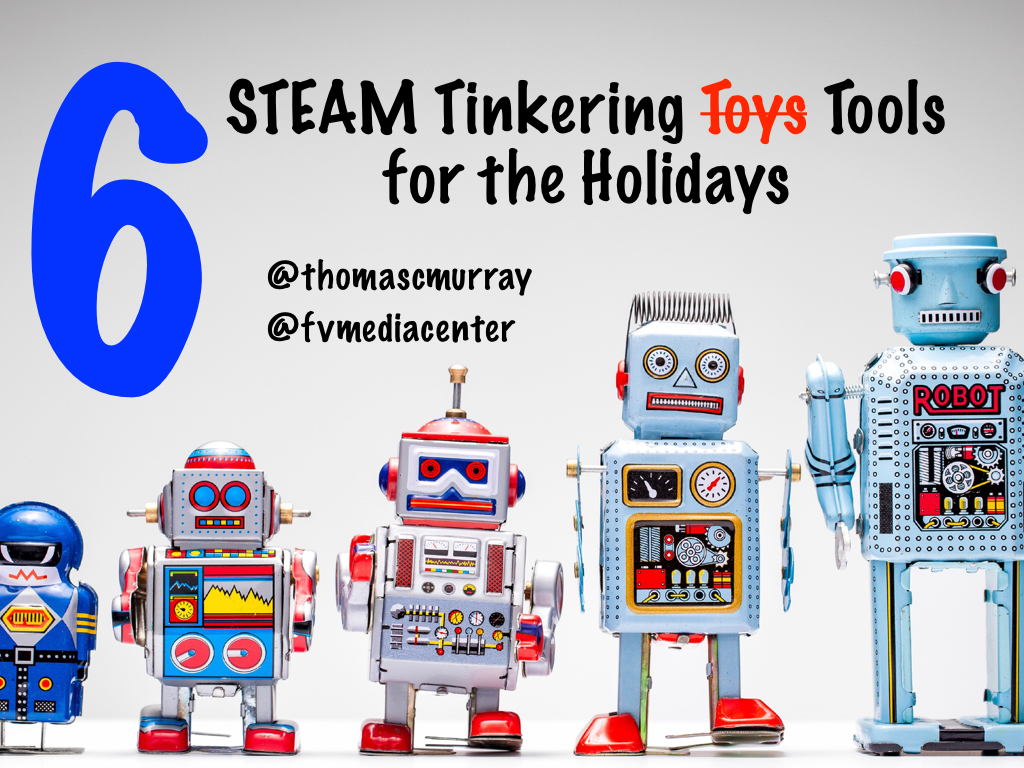
6 STEAM tinkering tools

6 STEAM tinkering tools for the holidays

BY THOMAS C. MURRAY AND SAMANTHA A. EDWARDS
December 18th, 2015

robots-coding-toys

Engage kids of all ages with these STEM and coding learning toyssteam-tools


The year that was brought with it a renewed, and much welcome, interest in science and technology, as STEAM, makerspaces, 3D printing, and coding all became hot topics. Each year, as parents look to celebrate the various holidays with our kids, many of us rack our brains trying to find gifts that are both fun and educational. This year is no different and fortunately, the latest STEAM push has made many of the learning tools very desirable as holiday gifts.
The following are six ed-tech tools that will undoubtedly spark the creative and innovative side of kids of all ages (parents and teachers included). These tools are dynamic, engaging, and fun for everyone. Best of all, they’ll help students focus on higher-order thinking skills as they make, design, create, and code their way into 2016.

Osmo

Designed for kids ages 5-13, this unique gaming accessory works with an iPad to offer interactive learning experiences through five games — TangramWordsNumbers,Newton, and Masterpiece. One of Time Magazine’s “2014 Best Inventions of the Year,” more than 7,500 schools are already teaching with Osmo. From spacial to literacy skills, the learning games that come with Osmo give kids an opportunity to practice social skills while learning critical thinking skills. Aimed at bringing “iPad addicted kids back to life,” as the Wall Street Journal put it, the Osmo…is meant to break the zombie-like stares and bring more of the real world back into the mix, by providing games that interact with just about any physical object—pen, paper, blocks, even toys your kids already own.”

Makey Makey

Make some magic this holiday season. Inspired by the Maker Movement, this JoyLabzcreated invention kit for all ages combines computer programming and hands-on maker tools limited only by imagination. Whether your plan is to turn a banana into a piano, play Super Mario Bros on a Play-Doh game pad, design a pencil joystick to play Pac-Man, or create floor pads to master Dance Dance Revolution, your child’s creativity will be pushed, pressed, and plugged-in as they think critically and have a blast.

Ozobot Bit

Measuring in at slightly more than an inch, this bite-sized programmable robot is one of the world’s smallest — but great things come in small packages. The Ozobot’s multi-level interactive capabilities make it perfect for a beginning programmer that would like to explore a color-based coding language, as well as the seasoned programmer looking for a bigger challenge (via OzoBlockly-a block-based visual editor). There is something for every type of thinker with this tiny tinker robot. According USA Today, “With…Ozobot Bit, Kids can graduate to “if,then” programming.”

Dash and Dot

Parents will find themselves dashing through the snow to pick up Wonder Workshop’s adorable robotic duo this holiday season — Dash and Dot. Kid-friendly and programmable, the pair come with five free apps to explore a variety of skills including coding, sequencing, measurement, problem solving, and critical thinking. Dash and Dot come fully assembled and ready for their first adventure only minutes after taking them out of the box. Like any well-maketed toy, don’t forget the accessories. Some favoritesinclude Dash’s Xylophone, Building Brick Connectors, and even a launcher! From the 2015 National Parenting Gold Award to the Time To Play Magazine 2015 Holiday Most Wanted List, and a myriad of other awards, Dash and Dot have an award case that makes other robots jealous.

Gizmos and Gadgets Kit

Gizmos and Gadgets is LittleBits’s most popular kit, and embraces true STEAM curricular integration. The well-designed kit comes with 15 electronic building blocks and easy-to-follow guides and instructions that include both text and photos, as well as accessories to fire up the imagination and spark creativity. “With more than 60 color-coded modules, there’s nearly an infinite amount of hacking, programming, and playing that kids can do with this easy-to-use playset,” writes Time.

Sphero SPRK Edition

The clear polycarbonate shell of this transparent ball of robotic fun enables students to feel closer to the robotic action inside by viewing all of the components that make it maneuver. SPRK builds confidence for beginning coders, while providing veteran programmers an opportunity to flourish through a variety of user-friendly apps. This programmable Sphero robot will SPRK the imagination of any student as they navigate their way through rolls, spins, flips, and color changes (build an obstacle course and try and get Sphero through for an added challenge). Its text-based programming language, OVAL, is hidden behind an easy-to-use block-based format. Collaboration is encouraged by free access to the SPRK Lightning Lab, which is a hub of learning and sharing for all Sphero users, both iOS and Android. Also, if your child is a fan of Star Wars — and who isn’t this week? — check out the Sphero’s droid-inspired BB-8.

Whether it’s coding, making, or building, there’s something for every child this holiday season that can help them tap creativity, develop high level thinking skills, while learning through play. These six ed-tech learning tools are sure to be a hit this holiday season, as well as something teachers will appreciate and kids will love.