Monday, 9 May 2016

Myths in Education, or How Bad Teaching Is Encouraged

source
 https://momentssnippetsspirals.wordpress.com/2016/02/22/myths-in-education-or-how-bad-teaching-is-encouraged/

I thought I would not have to blog about these fads again but it seems they have the strange ability to be reborn every single year and surface in professional development courses as well as in tweets, blog posts, and conversations within the education community. The reasons are different, ranging from ignorance to vested interests, but the effect is the same: poorer teaching. And no, you are not a bad teacher because you used them but you are a less effective one. We need to learn to dissociate our practice (which can have flaws) from our beliefs formed in the background of consistent bad professional development provided by schools.
Let’s see these monsters in their entire splendor:
  1. The Cone of Learning / The Learning Pyramid
  2. Learning Styles
  3. Right-Left Brain
  4. Brain Gym
  5. Brain-Based Learning
  6. Multiple Intelligences
The Learning Pyramid – a complete bogus
Where does it originate? Edgar Dale’s Cone of Experience (1946) was an exclusively theoretical model for audio-visual media, it did NOT include any percentages, and Dale himself insisted that the classifications should NOT be regarded as “any sort of hierarchy or rank order”.
Where did the percentages come from? Don’t laugh. They were first published by an employee of Mobil Oil Company in 1967, writing in the magazine Film and Audio-Visual Communications. This employee, D.G. Threichler, provided NO evidence for the figures but the education community accepted the percentages nonetheless.
PicMonkey Collage
References:
The Learning Pyramid Deception, Institute for Learning Professionals
Cone of Learning or Cone of Shame? , Daniel T. Willingham
I could go on and on with evidence – just type “cone of learning debunked” and you’ll see hundreds of papers on the topic.
Learning Styles – no, really, they do not exist
I am sure you came across this numerous times and some of you, more unfortunate, had to design lesson plans accordingly and meet the “various learning styles of students”. Well, they were debunked over and over again by experts, from psychologists to educationalists and research.
The studies that purport to provide evidence for learning styles “fail to satisfy key criteria for scientific validity.” (Hal Pasher et al,Psychological Science in the Public Interest, 2009)
“VAK (n.n. visual, auditory, kinesthetic styles) might, if it has any effect at all, be actually harming the academic prospects of children.” (Professor John Geake, Neuormythologies in Education, 2008)
Many blogs were written and research evidence piled up for more than a decade yet this myth continues to be embraced by schools and, consequently, teachers.
VAK
Learning Styles Debunked, Psychological Science
Neuromyth 3 – Center for Research and Innovation, OECD
Make It Stick, Peter C. Browns et al
Left-Right Brain – no such thing
“The myth probably took root in the 1800s, when scientists discovered that an injury to one side of the brain often caused a loss of specific abilities. The myth gained ground in the 1960s, when scientists studied epilepsy patients who had surgery to sever the connection between the two hemispheres. 
But more recently, brain scan technology has revealed that (…) the two hemispheres are in fact highly complementary.”  Brain Myths, BrainHQ
” The application of this notion to educational practice seems, therefore, overly simplistic and even dubious.
The notion of different hemispheric thinking styles is based on an erroneous premise: each brain hemisphere is specialized and therefore each must function independently with a different thinking style. Furthermore, there is no direct scientific evidence supporting the idea that different thinking styles lie within each hemisphere. Indeed, deriving different hemispheric thinking styles from functional asymmetries is quite a bold venture, which oversimplifies and misinterprets scientific findings.” Neuromyth 6, Center for Research and Innovation, OECD
“The notion that people are dominantly left- or right-brained never had a solid foundation in neuroscience, and now the best evidence we have is convincingly negative.” Left-Brain Right-Brain Myth, Science-Based Medicine
LR Brain
Brain Gym® – more snake oil in education
This was one of the most entertaining nonsensical claims sold to and, unfortunately bought by educators. Did I tell you it is used in 80 countries?
The website is riddled with hilarious statements backed by zero evidence. We learn about “crawling, drawing, tracing symbols in the air, yawning, and drinking water” as efficient methods to enhance learning…except they do not.
“Brain Gym was created in the 1980’s by Dr. Paul Dennison and Gail E. Dennison, who ‘were seeking more effective ways to help children and adults who had been identified as ‘learning disabled.’ They drew from a large body of research by developmental specialists who had been experimenting with using physical movement to enhance learning ability.” They called their work Educational Kinesiology or Edu-K for short. Paul worked with chiropractor Richard Tyler,* a friend of Arnold Schwarzenegger’s and a proponent of “alternative chiropractic.”
Go figure. But there is more.
“Unfortunately, the research they drew on has been widely discredited (Bruer 2004; Hyatt 2007; Novella 1996) and the follow-up research on the program itself is laughably inadequate. There have been only a few published studies on Brain Gym. One involved four participants, one of whom was the author of the study. Three were published in a journal that requires the authors to pay for publication. Another study has serious methodological flaws.”
Brain GYm
Brain Gym, From Abracadabra to Zombies , The Skeptic’s Dicionary
Brain Gym Scandal , Ben Goldacre
Brain-Based Learning – because learning does not happen in the brain, sic!
I know. You can hardly suppress a smile. Replace “brain” with any number of words you wish. For instance, “nose-based learning”. Or “chocolate-based learning”.
Besides the hilarious linguistic use  (it is the brain that coordinates all learning, regardless of the type of stimuli, i.e. visual, and the skills that are being built, i.e. motor), “brain-based learning strategies” seem to be the most dangerous *because* they seem supported by neuroscience and those promoting them intentionally misuse scientific findings. We all know that if there is “evidence” or some statistics thrown in, people are more prone to accepting claims.
“This is a common tactic. Many of these companies have an impressive-looking page of research on their websites. On closer inspection, these turn out to consist of articles only vaguely related to their claims.
Such marketing tactics are not new, and it is hard to get too morally exercised over a group of business people finding a new way of scamming another group. But consider the growth of businesses that target parents, teachers, and schools, using similar language.
Educational neuroscience is a thriving field of research, and there are many excellent and doubtless well-meaning researchers doing rigorous and valuable work in the area. Unfortunately, there are also businesses that want to exploit teachers’ lack of experience and middle-class parental anxieties about school attainment.” (Matt Wal, Researcher in Brain Imaging, Imperial College London)
In many ways, repackaging flawed research and selling it to schools so that they “improve” learning reminds me, sadly, about Dr. Fox lecture where the experimenters proved that even nonsense talk can be easily accepted by listeners since they are not experts in the field.
I recommend that you read Dr. Will Thalheimer’s latest post (Brain-Based Learning and What Neuroscience Says) as he has evidence, interviews, as well as a clear argument as to why these “strategies” can harm education in the long run.
Brain based
Multiple Intelligences – deceivingly optimistic
All of us know about Gardner’s MI theory. Unfortunately, it has never been supported by research for various reasons.
First, the use of terms was ambiguous and not even later was there an agreement as to what each of them stands for.
Secondly, little empirical research was conducted during this time: something that cannot be isolated and assessed (i.e. “naturalistic intelligence”) cannot claim scientific validity.
Thirdly, the greatest majority of scientists do not really accept the theory.
“Lynn Waterhouse in 2006 found no published studies at all that supported the validity of the theory. Even though Gardner first made his theory public in 1983, the first empirical study to test the theory was not published until 23 years later (Visser, et al., 2006a) and the results were not supportive. Multiple intelligences theory can hardly be described as scientifically generative.
Gardner’s theory of multiple intelligences looks to be a confused and nebulous set of claims that have not been empirically validated. Many of Gardner’s proposed “intelligences” appear to be explainable in terms of existing concepts of personality and general intelligence, so the theory does not really offer anything new. Additionally, some of the proposed “intelligences” arepoorly defined (particularly intrapersonal) and others (e.g. musical) may be more usefully thought of as skills or talents. The popularity of Gardner’s theories in educational contexts may reflect its sentimental and intuitive appeal but is not founded on any scientific evidence for the validity of the concept.” (The Illusory Theory of Multiple Intelligences, in Psychology Today, Scott A. McGreal MSc)
Professor John Geake on Multiple Intelligences: “Neuroimaging studies do not support multiple intelligences; in fact, the opposite is true.” (Neuromyths and Why They Persist in the Classroom, Sense About Science)
MI
A Debate on Multiple Intelligences, Howard Gardner PhD and James Troub
……………………………………………………………………………………………………………..
In conclusion, do not just roll your eyes when one or more of these fads are discussed in your PD meetings. Show the evidence and help discourage bad practice. We owe it to our students to teach better than this. And to our stakeholders to stop wasting money on programs that hardly make any real difference in learning, or worse, may cripple it.
And I leave you with a chart I created two years ago – how to deal with any claims, ed. program, or research (I am @surreallyno on Twitter).
DT WIllingham (2)
*Update:
A report on neuromyths and teacher training was released in January (see below) – please read this article prior to the paper – We Need to Rewrite the Textbook on How to Teach
*Update 2 – Thanks to @Frank Lee on Twitter I am able to share the video whose link he sent (thank you, Frank).
“Learning Styles and Why the Myth Persists”
Dr. Tesia Marshik is an Assistant Professor of Psychology at the University of Wisconsin-La Crosse. Her research interests in educational psychology include student motivation, self-regulation, and teacher-student relationships.


Wednesday, 20 April 2016

SEND resources

SEN

Resources for supporting students with Special Educational Needs in Computing


  • There is a collection of ideas for teaching Computing to SEND pupils at: http://sencomputing.wikispaces.com/ Any further contributions welcome. This also has a page linking to resources gathered at the SEND Computing Conference in Dec 2015.
  • Computing ITT and CPD – A collection of teacher-curated resources to deliver the new computing curriculum. Includes a Special Educational Needs and Disabilities page with links to resources, equipment and research.
  • Barefoot Computing Project – A collection of resources to help teachers of Computing, including resources explaining the key computational thinking concepts, and some new teaching activities aimed at teachers of students with SEN.
  • Somerset County Council ELIM SEND Computing Resources – Some excellent resources from the eLearning and Information Management Team, including Computational Thinking for SEN, and Programming Progression for Learners with Complex Needs. There is some additional information on SEND here.
  • http://sheffieldclc.net/ has some Scratch resources for SEND under the Resources tab, both to use as a resource for teaching computational thinking, and also for introducing Scratch.
  • http://gesturesen.wikispaces.com is a very useful wiki on a number of gesture-based technologies for those students with severe and profound learning difficulties, who won’t be able to access the Computing curriculum, but can have meaningful interactions with content through Eye Gaze, iPads, Kinect etc.
  • Revised P Scales for Computing – a group of educators have been working on an alternative to the P Scales for Computing, which don’t really reflect the content of the new Programs of Study. The first draft of this can be viewed in our Resources section here, and will be useful for teachers wanting to know what Computing looks like for young people working at these levels.
  • #CASChat: How do I make Computing appropriate for SEN pupils? – Storify of the #CASChat 6/10/15.
  • Dr Maya Israel’s blog post on inclusion in CS education for code.org.

Wednesday, 23 March 2016

The 4 conditions that support deeper learning

deeper-learning

Deeper learning competencies serve as “North Star” for a new vision of teaching, according to a new report

Teachers must exchange their traditional instructor role for that of a “learning strategist” in order to achieve deeper learning outcomes, according to a new white paper from the nonprofit National Commission on Teaching and America’s Future (NCTAF) and ConsultEd Strategists.
The report’s authors also found that teachers who do achieve deeper learning with their students personalize learning experiences, apply real-world knowledge to learning, and use technology in a way that enhances and empowers student learning.
Deeper learning refers to the competencies, knowledge, and skills that students must develop to be successful post-K-12. There are more than 500 schools across the country that incorporate various types of deeper learning methods.
The white paper, How Deeper Learning Can Create a New Vision for Teaching, describes a new vision for teaching and outlines how teachers’ roles and teaching conditions can best support deeper learning for students.
“Our goal was to highlight and document that teachers need support and training as they make shifts in their practice and in the way they work with colleagues,” said Elizabeth Foster, an author of the white paper and NCTAF’s Vice President for Strategic Initiatives. “We wanted to draw out how teachers, who share a vision of deeper learning for their students, adapt their strategies and take on new roles. In addition, it was also necessary to highlight the kinds of conditions that facilitate teaching for deeper learning, such as a learning culture based on trust and professionalism, shared responsibility for student learning, embedded professional learning, and time for meaningful collaboration.”
Drs. Monica Martinez and Dennis McGrath, ConsultEd Strategists and co-authors of the white paper, analyzed eight schools for their book “Deeper Learning: How Eight Innovative Public Schools Are Transforming Education in the 21st Century,” and drew on that research for this paper.
They found that teachers who are achieving deeper learning outcomes:
• Empower students as learners
• Contextualize knowledge so it is coherent
• Connect learning to real world experiences
• Extend learning beyond the school
• Inspire students by customizing learning experiences
• Purposefully incorporate technology to enhance (not automate) learning
“These strategies are the heart and soul of 21st century teaching and learning,” said Dr. Martinez. “Far too many American schools are not adequately preparing students for the realities of their future work and lives. We hope the examples of what teachers across the country are doing to teach for deeper learning will inspire and inform educators in all schools.”

4 conditions that support deeper learning

“If we are truly going to achieve the kind of learning that is challenging, meaningful and relevant to students lives and experiences , we need to focus on putting conditions in place that support teachers – their learning, their development, and their collaboration time,” said Foster.
The white paper outlines four key conditions, each sequential and building upon one another, that should be in place to enable and support teaching for deeper learning: 1) establishing a learning culture; 2) creating shared responsibility for student learning; 3) establishing a culture of trust and professionalism; and 4) preserving time for teachers to collaborate.
“If these conditions are in place in our schools, then the sky is the limit for all students to thrive in an ever-evolving world,” said Dr. McGrath.
Deeper learning and new roles for teachers
The white paper makes the case that the role of the teacher has to change to that of a learning strategist – an educator who shifts among a range of roles including learning designer, facilitator, networker, and an adviser.
Those new educator roles will include:
• Learning designer: In this role, teachers are adapting learning experiences by backward mapping from specific outcomes to design complex and connected curricula that offer students frequent opportunities to do meaningful work and the opportunity to explore big ideas and essential questions.
• Facilitator: Instead of being the gatekeeper of knowledge, teachers become the gateway to knowledge. Teachers no longer need to be the sole source of information given the access to information that technology provides, so teachers can now shift their role to that of knowledge facilitator.
• Networker: Deeper learning teachers also take on the role of networker as they regularly engage people in the community to enhance their teaching, enrich their curricula and projects, and provide students with access to a wide range of knowledge.
• Advisor: Teachers become involved in interpersonal issues as well, becoming a coach, counselor, or mentor offering advice, encouragement, support and guidance when most needed.
The white paper offers examples of schools across different contexts and settings where teachers have embraced these new roles to engage students in meaningful, personalized learning. Featured schools include: Avalon School in Minneapolis, Minn.; Casco Bay High School in Casco Bay, Maine; High Tech High in San Diego, Calif.; Impact Academy in Hayward, Calif.; King Middle School in Portland, Maine; MC2 STEM High School in Cleveland, Ohio; and Science Leadership Academy in Philadelphia, Penn.
Future recommendations
According to the white paper, the future of teaching embraces a forward-thinking, student-centered approach to learning to ensure students are ready for the future.
Recommendations to support that new vision for teaching include:
• Spread the word. Encourage teachers to share promising practices to make connections between what they are already doing that facilitates deeper learning and new ideas for how to expand their efforts.
• Mirror what we want for students. Just as students need opportunities to develop as curious learners, work collaboratively, and connect with community resources and issues; teachers need the same.
• Begin early. Learning how to teach for deeper learning student outcomes should begin during preparation, before new teachers enter the profession.
• Adapt and reorient existing structures. Policy makers and school leaders should rethink existing policies that could be used more effectively, such as those that address time and planning, assessment of student progress, and professional learning communities.

Thursday, 11 February 2016

Contemporary educational ideas all my staff should know about Tom Sherrington

Key ideas from different sources.
As I look ahead to starting my new job at Highbury Grove,  I’m thinking about all the conversations we are going to have about learning.  To a large degree I want my teachers to be as up-to-date as possible within their own subject domains. They should know the latest OfSTED position ( eg with Moving English Forward or Mathematics: made to measure ) and be up to speed with exam specifications and assessment requirements.  Subject knowledge and subject-specific pedagogical knowledge are going to be key drivers of everything we do.
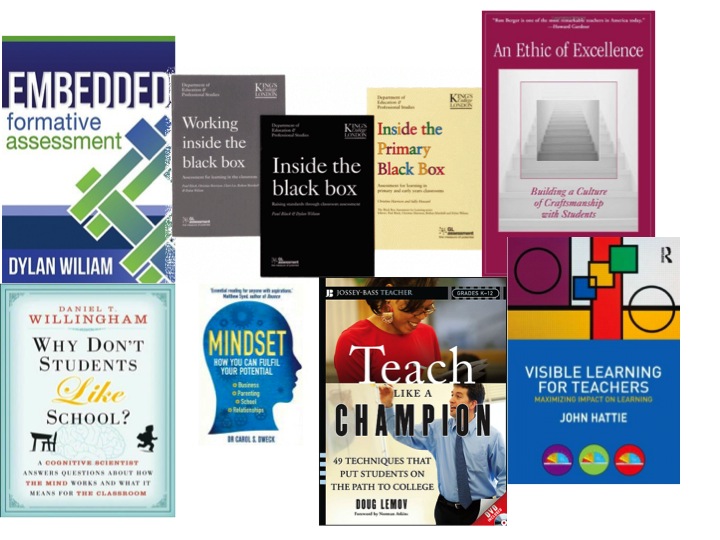
However, in order to fuel the collaborative effort of reaching the ambitious goals we have for the school, we’ll need to establish a shared conceptual language for talking about teaching across the school as well as within departments. Inevitably, different teachers will have engaged to different degrees with certain ideas depending on the books they’ve read, conferences they’ve been to and blogs they’ve browsed through and the content of their PGCE or other ITE programme.  It strikes me that it would be a huge benefit to us all if we’re more or less on the same page when we’re discussing contemporary ideas about pedagogy, learning, assessment, motivation, neuroscience and so on.   I don’t want people quoting half-remembered snippets from a Dylan Wiliam thing they attended years ago or citing Hattie effect sizes as absolute measures or talking about Growth Mindset, never having engaged with what Carol Dweck has actually written.
One of my first actions, later this week in fact, will be to buy a ton of books to stock the staff CPD library.  I want to make it easy for everyone to read the books that will inform our discussions.  Already, we’ve bought in copies of Dylan Wiliam’s Embedded Formative Assessment, Hattie’s Visible Learning for Teachers and Martin Robinson’s Trivium 21st C.   But there is so much more for us all to absorb and share.
Over the last two years, I’ve found that I can engage much better with the ideas in some of these books when I’ve seen the authors express their ideas directly – either in person at a conference or through some of the video material on the internet.  In this post I’ve gathered some of the videos that I’ll be recommending that all of my staff engage with at an early stage.  Each one links to a key academic or thinker and their ideas.  Of course, there is also the growing world of teacher bloggers and teacher authors to engage with too and I’ll be promoting general engagement with all of that material – especially the people on my blog roll.
However, to ensure we have strong common ground, I want to focus on a few key researcher-writers and their work:
Visible Learning: John Hattie – the idea of measuring impact
John Hattie’s work provides an important insight into the nature of educational research and the notion of measuring impact.  The idea that some strategies can be shown to have had more impact on average over time relative to others is crucial and his general message about the implications for teachers and the profession is very strong.  This video, (with a counterpart Part 1) gives a very good idea of Hattie’s thinking.  Of course, the effect size concept is problematic and is open to misinterpretation. We’ll need to have that discussion – but people will need to know the principles first.


Formative Assessment: Dylan Wiliam
Dylan Wiliam is someone most people know of even if they haven’t engaged directly with him or his work.  His websitehttp://www.dylanwiliam.org/Dylan_Wiliams_website/Welcome.html is packed with materials to browse through.  He has been leading the way for the last two decades in getting teachers to think about what they’re doing and why. Inside the Black Box was a revelation when we first encountered it back in the 90s.  However, following the national adoption of AfL 10 years ago, lots of the ideas have become rather distorted, spawning various superficial AfL gimmicks or misconceptions about the meaning of ‘formative’ – but I firmly believe that every teacher should know very clearly what Dylan is saying.  This video is one of several recordings of his engaging presentations (cut in at 1 min 30 to get over the long musical intro!)  Alongside his recent book, I think that videos like this could help us to establish a good shared understanding of what we mean by formative assessment and feedback and what these things can look like in practice.

 Lessons from Cognitive Science:  Daniel T Willingham
The field of cognitive science is giving us ever greater insights into how learning works.  There are lots of people in this field but Daniel T Willingham does a very good job of making the ideas accessible and relevant to our school experience.  This book, Why don’t students like school, is a must-read. He provides a handy summary in the concluding chapter which gives a feel for the key ideas and their implications for our practice.  In particular it gives a firm steer in terms of the discourse around thinking, memory, teaching factual knowledge and the need for conscious effort and feedback to secure improvement.
photo (73)
A great summary of Daniel Willingham’s book provided in the concluding chapter.
This interview with Tom Bennett for ResearchEd 2013 gives a superb insight into Dan’s thinking:

I’d also recommend watching this gem of video where Dan explains why learning styles don’t exist:

Robert Bjork and Desirable Difficulties
On YouTube there is a whole series of fascinating short videos where Robert Bjork explains some key findings from his research into memory.  From these you can get an idea of his findings and the general idea of ‘desirable difficulties’ necessary to secure long-term memory, possibly at the expense of the sense of short-term progress.  This clip is a good introduction but I’d recommend watching them all.  If we can all talk about storage, retrieval, interleaving and so on, we’ll be in a better place.

An Ethic of Excellence: Ron Berger
Ron’s book is an inspiration to many people who read it.  The attitudes that is promotes are so powerful, providing significant food for thought as we look at shaping our ethos.   A specific example is shown through this classic Austin’s Butterfly video about the power of critique.  It’s the spirit of it that is most crucial – that we shouldn’t accept mediocrity from any student; we should have aspirational goals for everyone and use specific techniques to enable students to reach them.   I’ll be referring to Austin’s Butterfly a lot – as I have done in a couple of blog posts here and here.

 Guy Claxton and ‘below the line’ learning
I find that Guy Claxton is often misrepresented as being ‘anti-knowledge’ or his ideas are adopted by evangelicals who elevate Building Learning Power to the level of some kind of concrete theory of learning that must be followed almost on principle.  For me, Guy’s ideas and his mode of presentation, provide a useful provocation to question some of our assumptions about what we learn, how we learn and why we learn in certain ways.  The idea that pedagogy could be devised to deliver a deep, knowledge-rich curriculum that simultaneously gives space for students to develop certain dispositions that might serve them well in the future – is inviting. It might be difficult to deliver without losing one or other aspect and that’s the challenge. But the idea is sound and certainly worthy of debate in a school.   To me, Guy is promoting ‘knowledge AND dispositions’, not one or the other. Here he is:

 Carol Dweck: Growth Mindset.
Growth Mindset is so in vogue at the moment, it is natural for anyone who has been hit by a bandwagon to approach this cautiously. However, as with Guy Claxton’s ideas, there is great power in considering the extent to which  student attitudes to learning are influenced at every level of the school – in all of the messages we give in public and in the classroom.  The issue of labelling students such that they have their horizons limited or are lulled into complacency is very common; we’re all guilty of it to some degree.  Here Carol is setting out the key ideas:

Pygmalion Effect: Robert Rosenthal
This video tells the story of some research that shows the power of teacher expectations. It links in with Hattie’s research – as this is one of the highest effects he cites.  Higher teacher expectations lead to better outcomes.  Obvious? Well – it’s worth watching this to see how teachers can change their interactions with students leading to better outcomes when their expectations are raised deliberately:

 Doug Lemov:  Practice and Rigour
I’d like my staff to know about Doug Lemov and his two books: Teach Like A Champion and Practice Perfect.  Of course the American context is different but there is huge merit in engaging in several of Doug’s ideas.  Strategies like 100% or Right is Right show how very high expectations and rigour in discussion can be achieved.  His ideas about teachers’ practice are also very interesting – we won’t get better as fast as we could if just repeat our mistakes over and over again in lessons.   We need to rehearse and practice specific strategies until we do them better.

Martin Robinson: The Trivium 21st C
I have already sent my staff a suggested reading list and this wonderful book was at the top.  I’ve written about the book in this review and I am very excited about working with my staff (and with Martin’s Trivium network) to explore how the ideas behind Grammar, Dialectic and Rhetoric can be brought to life in the classroom and beyond.
@SurrealAnarchy Martin Robinson's wonderful book
@SurrealAnarchy Martin Robinson’s wonderful book
Lesson Study
The NTEN Lesson Study Cycle.
I’d like all of my staff to know in principle what Lesson Study is and how they could engage with it if they choose.  I might use some of my own posts on this to get people started but, beyond that, there is a wealth of literature we can access via NTEN and other sources.    The first step is to make sure everyone knows about it.
There are lots of other ideas we’ll need to wrestle with together – ideas about Behaviour Management, technology and assessment  for example. The goal should be that we’re always seeking to make sure the latest thinking is made available to everyone and that everyone does their best to engage with it.   That way we’ll have the most fruitful discussions about taking the school forward.